
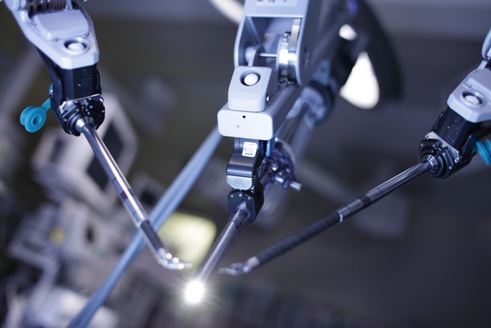
Thoracic surgery has undergone a dramatic transformation over the past century, and today’s patients are benefiting from safer, more precise and far less painful procedures. According to Dr. Ammar Asban, thoracic surgeon with Northside Thoracic Surgery, the driving force behind this change is minimally invasive and robotic technology.
“So why does minimally invasive matter?” Dr. Asban explained. “We all focus on patient outcomes, especially length of stay, post-op pain and complications. And this is where the robot really has the advantage.”
From large incisions to tiny ports
In the early 1900s, lung and chest surgeries were performed through open thoracotomies, which required spreading or cutting ribs. While these operations helped establish modern cancer surgery, they came with a heavy toll. Dr. Asban noted that open thoracotomy had “high morbidities, prolonged recovery, mainly from pain, and post-operative atelectasis and pneumonia,” which delayed further cancer treatment.
The 1990s brought video-assisted thoracoscopic surgery, or VATS, allowing surgeons to operate through small incisions using a camera. This reduced pain and sped up recovery, but it had limits.
As Dr. Asban put it, “It’s a very long instrument with a very limited articulation, especially on the wrist part of the instrument … the video display in the VATS is only two-dimensional compared to 3D in robotic surgery.”
Why the robot makes a difference
Robotic surgery builds on minimally invasive techniques but gives surgeons more control and better vision. Dr. Asban described the robotic view as “three high-definition, extremely good, 10 times vision,” combined with wristed instruments that allow “almost 360 degrees of articulation of the robotic arms.”
These advantages matter most in complex cancer cases. Robotic surgery has been shown to reduce conversions to open surgery and may allow surgeons to remove more lymph nodes. “In some series, robotic surgery illustrates a higher number of lymph nodes, which subsequently led to upstaging of some patients,” meaning doctors get a more accurate picture of how far a cancer has spread.
Patients also tend to recover faster.
“Robotic patients have a shorter length of stay and a lower pain score. It’s only four small incisions,” Dr. Asban said.
Today, robotic surgery has become the dominant minimally invasive approach. “As of today, about 70% to 80% of minimally invasive thoracic procedures in the United States … are all performed by a robot.”
Finding and removing tiny tumors with precision
One of the newest breakthroughs is robotic bronchoscopy, which helps doctors find and mark small lung nodules before surgery. Using robotic technology, doctors can navigate deep into the lungs and inject dye right next to a tumor.
Dr. Asban explained, “We inject an ICG dye to increase our accuracy and localization of 97%. And if you combine robotic bronchoscopy with intraoperative CT scan … the accuracy of up to 100%.”
This allows a “one-stop shop” where diagnosis, marking and surgical removal happen in a single visit, reducing delays and avoiding needle biopsies through the chest wall.
Teamwork behind every successful surgery
Even with advanced robots, great outcomes depend on teamwork. Dr. Asban emphasized that thoracic surgery “wouldn’t achieve an excellent outcome without the collaboration with our colleague from pulmonary oncology … radiology … radiation oncology … our anesthesia intraoperatively, our PACU team, our nursing staff … our NPs, our PAs … and then our team here in the clinic.”
This multidisciplinary coordination ensures that surgery, chemotherapy, immunotherapy and radiation therapy are timed correctly and safely.
What the future holds
The next generation of robots is already arriving. Intuitive Surgical’s new Da Vinci 5 includes “haptic feedback, meaning that you can actually feel the tumor,” and “telepresence, where another surgeon can proctor you or help you with an operation from a different institution.”
Artificial intelligence is also on the horizon. AI may soon help predict which lung cancers are more aggressive, guide surgeons during operations and even evaluate cancer margins in real time.
As Dr. Asban summarized, “Minimally invasive, particularly AI robotic surgery, is now the standard when it comes to thoracic surgery. It enhanced our precision … patient safety and excellent outcome.”
LEARN MORE ABOUT THORACIC SURGERY AT NORTHSIDE.